Auto Electrical Repair · Denton, TX · Since 1995
A car that clicks instead of cranks, headlights that dim at every stoplight, a battery that's dead again by morning — it's one system with three suspects, and swapping parts on a hunch gets expensive fast. Eagle has fixed Denton's cars since 1995: ASE-certified techs test the whole charging system — battery, alternator, starter, and the cables between them — then hand you a written estimate before any work begins.
Prefer to talk now? Call (940) 514-8690
Battery load test, charging output, voltage drop on cables and grounds — measured before anything gets replaced.
Certified technicians and three decades of shop standards behind every repair.
Denton drivers on the record about straight diagnostics and fair pricing.
Three decades fixing Denton's cars — long enough to have seen every electrical gremlin twice.
Snap and Synchrony options on approved credit — the fix doesn't have to wait for payday.
The 10-Second Triage
The first sound — or silence — out of a no-start car narrows the suspect list fast. Match yours before you buy a single part.
The starter's solenoid is snapping in, but the motor isn't turning the engine over. Usually the starter itself — though a corroded cable or bad ground can starve a good starter of current, which is exactly why we test before we replace.
That machine-gun chatter is low voltage: enough power to click the solenoid, not enough to spin the starter. A dead battery — or an alternator that stopped recharging it. Testing tells us which in minutes.
No power is reaching the circuit. A stone-dead battery, a corroded terminal, a failed ground strap or main connection — often the least expensive fix on this list once it's traced.
Your battery and starter are doing their jobs — the problem is fuel, spark, or a sensor. That's a scan-and-diagnose question, and it starts on our check-engine diagnostics page, not here.
The engine is running on stored battery power alone; the alternator isn't charging. You're on a countdown measured in minutes to an hour, and it ends wherever the car happens to be.
A jump start treats the symptom, not the cause. Either something is draining the battery overnight or the charging system never refilled it. We measure both before blaming the battery.
Whatever the sound, don't keep cranking — long, repeated cranking overheats a starter fast. Give it two or three tries, then call (940) 514-8690 and describe what you hear; after thirty years of no-starts, we can usually point you the right way on the phone.
The Most Misread Light on the Dash
When that red battery icon lights up while you're driving, the alternator has dropped out and everything — ignition, fuel pump, headlights — is draining whatever charge the battery has left. Depending on the car and the time of day, that's often less than an hour of driving. Head somewhere safe, switch off what you don't need, and call us before the car makes the decision for you.
One System, Three Jobs
Battery, starter, and alternator live or die together. See the loop once and the test-first rule explains itself.
The catch: a failed link anywhere gets blamed on the battery. A worn alternator quietly flattens a good battery, and a weak battery overworks a healthy starter until it fails too. That's why we test the whole loop before replacing any single part.
Test, Don't Guess
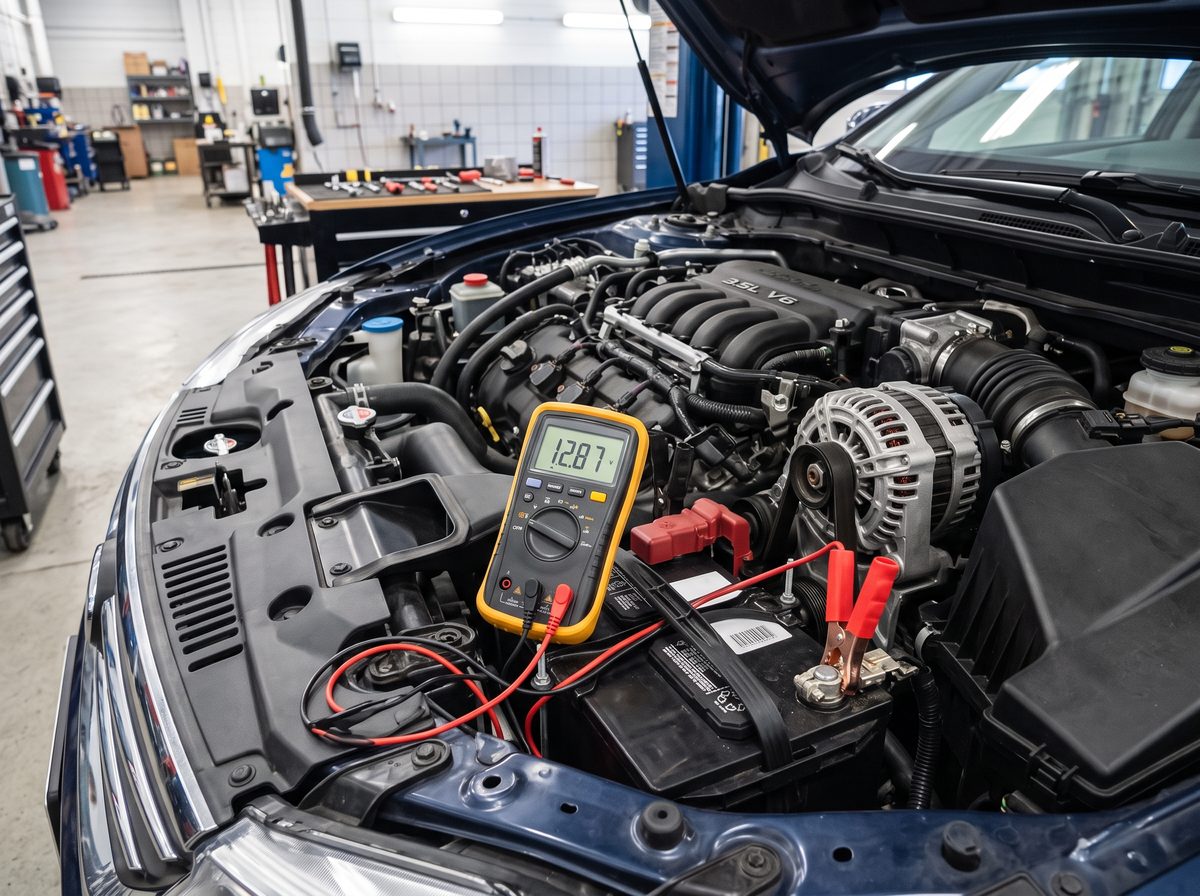
The parts-store route reads a resting battery in a parking lot and sends you home with whatever that maybe suggests. The guess-and-swap cycle — battery first, alternator next, starter after that — can end up costing more than the repair. Our first move is measurement:
Know the Boundary
Electrical faults are the great impostors of car trouble — and a few "electrical" symptoms aren't electrical at all. Here's where each path leads.
Warning-light and trouble-code diagnosis lives on our diagnostics page — that's where the scan happens. When the trace ends at an electrical fault, the fix comes back here.
Check Engine DiagnosticsA weak battery shows up in testing long before it strands you. Have the battery and charging system looked at with the multi-point inspection at your next oil change.
Oil Change & InspectionOne failure often takes the other with it, and the estimate can sting. Snap and Synchrony financing can spread it into payments — on approved credit, arranged before work starts.
Financing OptionsSlipping gears, a brake pull, weak A/C — whatever surfaces, every specialty is under this roof. One shop, one visit, no hand-offs.
All ServicesThose are early alternator signs — our guide shows the failure timeline before you're stranded.
Signs of a Bad AlternatorYou can't see a bad diode, so you're taking the shop's word for what failed. That's why the record matters: since 1995, Denton drivers keep writing the same things about this shop — diagnostics that found the real problem, fair prices, jobs done when promised. Read them before you hand over a key.
Go Deeper
Most no-start calls come down to one of two parts. Telling them apart before you buy either one saves the wasted trip.
They fail differently, and the difference is testable in minutes. A decision tree that tells you which one you're actually looking at.
Battery or Alternator?A rapid click and a single clunk mean two different things. Here's what each one points at before you replace anything.
Car Won't Start, Just ClicksGood to Know
It depends on the vehicle. Alternators vary widely in price, and on some engines the unit is buried deep enough that labor becomes the bigger line. Industry-wide, most alternator replacements land in the hundreds of dollars, with some vehicles running higher. We confirm the alternator actually failed before quoting anything, then put the exact number in a written estimate — and Snap or Synchrony financing is available on approved credit.
Also vehicle-dependent: some starters sit right on top of the engine, others hide under an intake manifold, and that access difference drives the labor. Industry-wide it's commonly a few hundred dollars installed. We test before we replace — a corroded cable can imitate a dead starter perfectly — and the real number goes in writing before any work begins.
From the driver's seat, you usually can't — that's the honest answer. The classic clues: a car that runs fine after a jump but dies again soon points at the alternator; slow, laboring cranks on cold mornings point at the battery; rapid clicking can be either. A charging-system test settles it in minutes, with numbers instead of a hunch.
Not far. That light means the alternator has stopped charging, so the car is running down whatever the battery has left — often less than an hour of driving, and less at night with the headlights on. When it's gone, the engine dies wherever you are. Head home or to the shop, switch off what you don't need, and call us.
Something in the car is staying awake — a control module that never sleeps, a trunk light, a stuck relay, an aftermarket accessory wired straight to power. That's a parasitic drain, and it will kill replacement batteries as fast as you can buy them. We measure the overnight draw and isolate the guilty circuit instead of treating the symptom.
Yes. Power windows and locks, headlights and taillights, gauges, fuse-box and relay faults, aftermarket wiring gone wrong — if it has a circuit, we can chase it. Accessory problems get the same meter-first diagnosis as a no-start, and the same written estimate before any repair.
Denton, TX · Since 1995
Call now or send the symptom through the quote form — we'll test the whole charging system, show you the readings, and put the fix in writing before any work begins. Serving Denton, Lewisville, Flower Mound, and all of North Texas.