Muffler & Exhaust Repair · Denton, TX · Since 1995
That sudden roar, the rattle under the floor, a rotten-egg smell, or a failed inspection — a failing exhaust is loud, but it's rarely a whole-new-system job. Eagle's ASE-certified techs find the actual failure point, tell you straight whether it's a section repair or a replacement, and put a written estimate in your hands before any work. Cars, trucks, and RVs, foreign and domestic, since 1995.
Prefer to talk now? Call (940) 514-8690
What It's Telling You
An exhaust rarely fails silently. Match what you're hearing or smelling below; each one points somewhere specific, and most are cheapest to fix the week they start.
The classic blown-muffler or rusted-pipe sound — exhaust is escaping before it ever reaches the muffler. Rarely dangerous on its own, but it only gets louder and rustier from here, and it fails the state safety inspection.
A loose heat shield, a broken hanger letting a pipe drag, or a cracked baffle rattling inside the muffler. Cheap to fix now; a dragging pipe or a dropped converter if it's left to wear.
A small leak at a joint, gasket, or crack — usually loudest on a cold start. Left alone, a leak upstream of the oxygen sensor can throw off the fuel mixture and trip the check-engine light.
That sulfur smell usually points at the catalytic converter. And if you smell exhaust INSIDE the cabin, treat it as urgent — those are the gases the system is supposed to route out the back, not into your lungs.
A loud or leaking exhaust fails the Texas safety check; emissions counties add the OBD test on top. Either way it's a fix-and-retest, and we'll tell you exactly what tripped it.
A crushed pipe, a clogged converter, or a leak fooling the O2 sensor can choke power and mileage. Worth a look before you chase it as an engine problem.
Smell exhaust inside the car? Roll the windows down, get out of it, and call us — that one doesn't wait for an appointment.
One Symptom That Isn't About Noise
Your exhaust system has one job the muffler never gets credit for: routing carbon monoxide — colorless, odorless, and dangerous — safely out the back of the car. A leak in the wrong spot can let those gases seep up into the cabin, and the sulfur or burnt smell that rides with them is often your only warning. If you smell exhaust inside the vehicle, drive with the windows down, never idle it in a closed garage, and get it checked now. This is the one exhaust problem we treat as urgent, every time.
Call (940) 514-8690How It Works
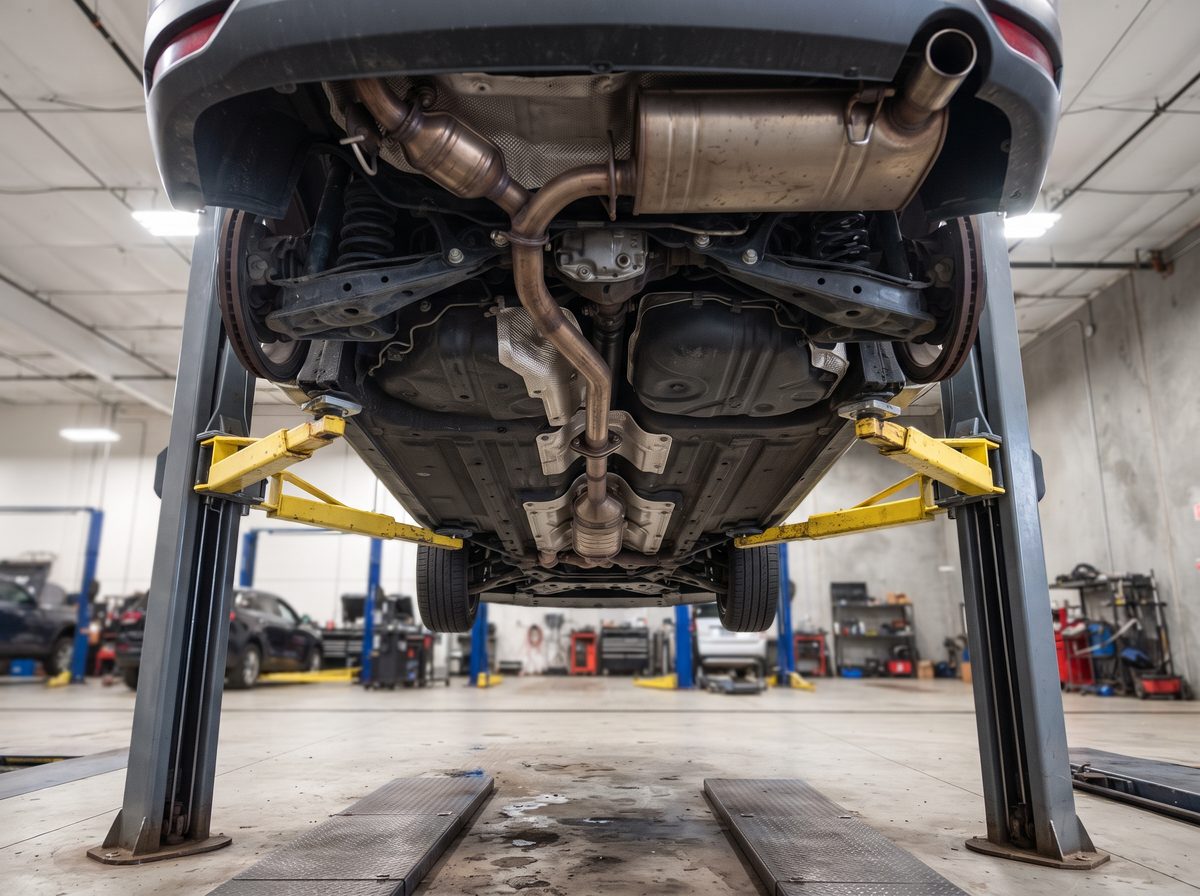
Your exhaust isn't one part — it's a chain of them, each with a job. Knowing the order is how you tell a cheap rattle from a real problem, because every joint and weld along the way is a place a leak can open.
Catalytic-converter trouble — a rattle from the middle, a rotten-egg smell, a P0420 code — has its own deep guide. Everything else on the line lives on this page.
The Real Choice
When a piece of exhaust fails, there are three ways forward — and the honest answer is usually the cheaper one. Here's the comparison we'd want if it were our truck.
| Often the fix Weld-in section repair Cut out the bad, splice in new | Full component replacement New muffler, pipe, or assembly | A clamp or a can The parts-store bandaid | |
|---|---|---|---|
| What it fixes | A rusted-through spot or cracked joint in an otherwise-sound system | A muffler, converter pipe, or assembly that's rotted or crushed past saving | Nothing lasting — it slows a leak for a while, then it's back louder |
| Keeps your factory parts | Yes — only the failed section is touched | No — the whole component is swapped out | Sort of — until the patched spot lets go |
| Relative cost | $ — usually the least expensive real fix | $$ — priced to the part and how buried it is | ¢ — cheapest today, paid for twice later |
| How long it lasts | Years, when the surrounding pipe is solid | The full service life of a new part | Weeks to a few months |
| Right when | The damage is local and the rest is healthy | Rust or damage runs the length of the system | You just need to get home tonight — then come see us |
Which one your exhaust needs is a diagnosis, not a guess. We find the real failure point and put the repair-or-replace recommendation in writing before any work begins — and when the smaller fix will hold, that's the one we'll tell you to buy.
Repair or Replace
Muffler chains make most of their money selling a full assembly. We start somewhere cheaper — finding the actual failure point, then telling you straight whether a section repair or a full replacement is the right call. More often than the chain would admit, it's the smaller one.
Before You Ask For It
A loud exhaust brings out some bad advice. Here's the straight version on the popular requests.
Just delete the muffler — it'll sound mean and free up power.
On a street-driven car in Texas, a muffler delete fails the state inspection and does nothing measurable for power on a stock engine — it only makes the car loud and ticket-prone. We won't cut the muffler off a daily driver. We'll fix the reason it got loud so it's quiet and legal again.
Gut the catalytic converter or hollow it out to save money.
Removing or gutting a converter is illegal under federal law, fails an emissions inspection, and usually sets a permanent P0420 code. If a converter is genuinely bad, the fix is the right replacement part — which our converter page walks through — never a hollowed-out shell.
Just clamp a patch over the rusty spot — it's fine.
A clamp-on patch or a wrap of muffler tape buys days, not a repair — the rust around it keeps spreading and the leak comes back louder. If the surrounding pipe is solid, a proper section repair costs little more and actually lasts.
None of this is about selling you the biggest job — two of the three above, we flat won't do. It's about fixing a loud exhaust in a way that passes inspection and stays fixed.
What It Costs
No two exhaust repairs are priced the same, and a number quoted blind over the phone is a guess. These are the levers that actually move an exhaust estimate — and yours goes in writing after we see the failure.
Rust vs. impact damage
A single rusted joint is a small repair; a system rotted end to end from years of short trips and road salt is a bigger one — the single largest swing.
Repair vs. replace
Splicing in a section costs less than a whole muffler, pipe, or assembly. The diagnosis decides which your exhaust actually needs.
Where the failure sits
A tailpipe is easy access; a manifold or an exhaust flange buried against the engine takes real labor to reach.
Vehicle & system type
A dual-exhaust truck, a diesel, or a stainless factory system carries more pipe and more parts than a compact's single exhaust.
Sensors in the path
If a failed oxygen sensor is tangled up in the repair, that's a part and a scan on top of the pipe work.
Diagnosis first, then a written estimate you approve before any work. If we open it up and the scope changes, you hear it from us before anything proceeds — never on the final bill.
Exhaust work is where upsells hide, so the record matters more than the promise: three decades of Denton drivers describing straight answers about what actually failed, fair prices on the fix, and work that passed inspection the first time. Read it before you decide.
Good to Know
It depends on what failed and whether a section repair or a full replacement is the right call — a single leaking joint is a modest job, a rotted-out system on a truck is a bigger one. Industry-wide, exhaust work runs from modest for a leak or a clamp-and-weld repair into the hundreds and up for a full assembly or a manifold. We diagnose it first and put real numbers in a written estimate before any work. Financing through Snap and Synchrony is available on approved credit.
A sudden roar or deep drone almost always means the exhaust is escaping before it reaches the muffler — a blown muffler, a rusted-through pipe, or a broken joint. It's rarely dangerous to the engine, but it gets louder and rustier the longer it runs, and a loud exhaust fails the Texas safety inspection. Get it looked at while it's still a section repair and not a whole system.
Often, yes. If the rest of your system is solid, we can repair the failed section rather than sell you a full assembly — usually the cheaper, longer-lasting fix. When the pipes are rotted end to end, patching one spot only moves the leak six inches down, and we'll tell you that instead. Either way, the repair-or-replace call goes in writing before any work begins.
Not on a street-driven vehicle. A muffler or catalytic-converter delete is illegal in Texas, fails the state inspection, and can void emissions compliance — so we won't cut one off a daily driver. What we will do is fix a loud exhaust the right way so it's quiet, legal, and passes. Off-road and race-only vehicles are a different conversation.
The sulfur smell usually points at the catalytic converter, which has its own page. But if you smell exhaust inside the cabin, treat it as urgent — those are gases the system is supposed to send out the back, not into the car. Drive with the windows down, keep it out of closed garages, and get it checked right away.
Yes — when a failed sensor is the confirmed cause. The catch is that an oxygen-sensor code doesn't always mean the sensor is bad; an exhaust leak upstream of it can trip the same code. We read and verify it on our Check-Engine Diagnostics side first, then replace the sensor here if that's the real fault.
Denton, TX · Since 1995
Call now or send the sound through the quote form. We find the real leak, tell you straight whether it's a section repair or a full replacement, and put it in a written estimate before any work — with free 20-mile towing on most vehicles and financing when a job runs big. Serving Denton, Lewisville, Flower Mound, and all of North Texas.