Radiator & Cooling System Repair in Denton, TX · Since 1995
A temperature gauge climbing through a Texas July is not a wait-and-see problem. Shut it down early and the fix is often a hose, a thermostat, or a radiator; keep driving and it becomes engine work. Eagle's ASE-certified techs pressure-test the system, prove what's failing, and put a written estimate in your hands before any work — cars, trucks, and RVs, foreign and domestic, since 1995.
Prefer to talk now? Call (940) 514-8690
Overheating Right Now?
What you do in the next two minutes decides whether this is a small repair or an engine. The order of operations, from behind the wheel:
It sounds backwards, but your heater core is a small second radiator. Max heat and fan pull warmth out of the engine and can buy you the minutes you need to stop somewhere safe.
A needle in the red, a coolant warning light, or steam from the hood means now — not the next exit. Find a safe spot, hazards on, engine off.
A hot cooling system is under pressure, and opening it can flash boiling coolant onto your hands and face. Let it cool — thirty minutes or more — before anyone touches that cap.
From the outside only: a puddle under the car, a burst hose, steam rising off the radiator? What you see is worth telling us — no tools required, no cap removed.
An engine that cooled back down isn't fixed — the next overheat is a mile away. Call (940) 514-8690 and we'll tell you straight whether it's safe to limp in or smarter to tow.
Why Stopping Early Matters
Modern aluminum engines have very little tolerance for heat. A few miles past the red line can warp a cylinder head or burn a head gasket — turning a hose-and-thermostat visit into machine-shop work. Shutting down early is the cheapest repair decision you will ever make; figuring out why it ran hot is ours: pressure test first, written estimate before any work.
Catch It Early
Most overheats send warnings for weeks first. Any of these is your cue to get the system tested before a Texas afternoon finds the weak spot for you.
A warmed-up gauge should hold steady. A slow creep in traffic or on grades means the system is losing capacity — thermostat, fans, or radiator.
That's coolant flashing off hot engine parts — a small leak announcing itself by smell, often before a single drop hits your driveway.
Coolant dries into a colored crust around hose clamps, the water pump, and radiator seams. Colored residue is a leak in progress.
Coolant isn't consumed — a sealed system holds its level for years. A tank that keeps dropping is leaking somewhere, visibly or not.
Your heater runs on engine coolant, so weak cabin heat often means low coolant, a stuck-open thermostat, or a clogged heater core.
That's no longer a warning sign — that's the event. Use the pull-over steps above and call before driving another mile.
A/C quit but the temperature gauge reads normal? Different system entirely — the next section sorts out which page you need.
Two Different "Cooling" Systems
Your car carries two cooling systems that share nothing but the word. This page is the engine's — radiator, coolant, thermostat, water pump — the system behind a climbing temperature gauge. The cold air at your vents is the A/C, a separate refrigerant loop with its own page. The fast sort:
How It Works
Your engine makes enough heat to destroy itself in minutes. A sealed, pressurized loop of coolant hauls that heat away — and every link below is a place the loop can fail.
The same loop feeds your heater core — and on many vehicles the radiator also cools the transmission through a built-in cooler. One system, with a lot riding on it.
Pattern Tells
Overheating isn't random — the conditions that trigger it point at the culprit. Find your pattern below; we confirm it with testing, not guesswork.
Moving air keeps everything cool at speed; at a standstill the fans have to do it alone. Overheating at stoplights that recovers on the open road points at the fans, their relays, or a debris-blocked radiator stack.
On the highway, airflow is free — if it still runs hot at speed, on grades, or while towing, the system is short on capacity: a clogged radiator core, a tired water pump, or a lower hose collapsing under suction.
A thermostat stuck shut blocks the loop before coolant ever reaches the radiator, so the gauge spikes almost immediately. Stuck open does the reverse — the engine never fully warms and the heater stays lukewarm.
A level that drops with nothing on the driveway means the coolant is going somewhere: seeping past a clamp and flashing off hot metal — or, the case we test for before ever naming it, into the engine itself.
These patterns are where diagnosis starts, not where it ends — a pressure test and live temperature data confirm the cause before we quote anything.
Finding the Leak
Coolant can escape as steam off hot parts and never leave a puddle. So we work in stages and stop the moment the cause is proven — you pay for the depth your problem needs, not a parts cannon.
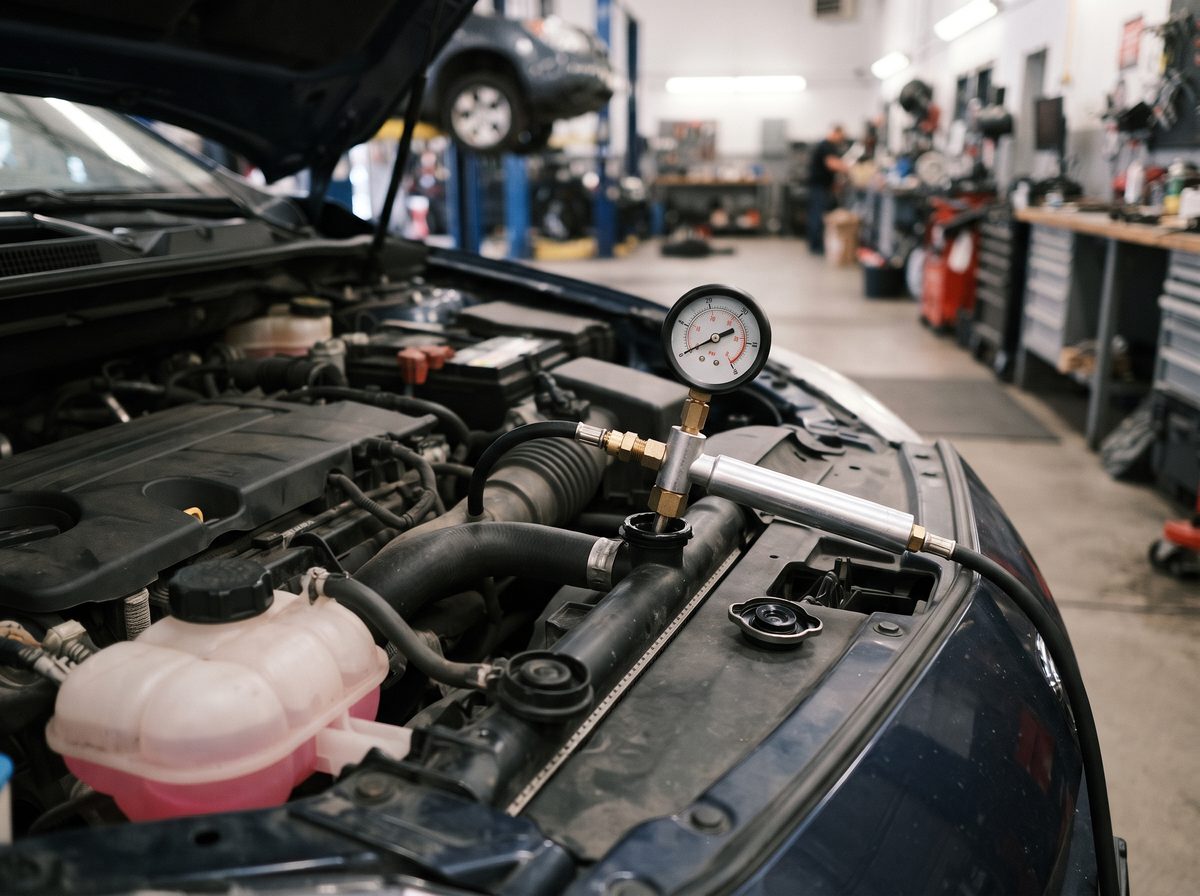
We pressurize the cold system to its rated cap pressure and watch the gauge hold — or fall — then sweep the usual suspects: hose clamps, radiator end tanks, the water pump's weep hole, heater hoses, the reservoir and cap itself.
Most external leaks are found and quoted right here.
Seeps that evaporate before they drip get UV dye added to the coolant. After a drive cycle, the escape path glows under blacklight — exact part, exact spot, no guessing.
Slow, hidden seeps pinpointed to the exact part.
When coolant vanishes with no external trace, we test it for combustion gases — the definitive check for a head-gasket breach. Nobody should hear those words as a guess; we confirm before we ever say them.
Internal leaks proven — or ruled out — before any big-job talk.
Whatever level it takes, the finding lands in plain English with a written estimate before any repair.
Go Deeper
Two cooling jobs that deserve their own deep dive — each done the same diagnose-first way.
If your reservoir keeps dropping, you have a leak. We pressure-test and dye-trace the exact source, then fix the part — not a can of stop-leak.
Coolant Leak RepairA flush done by your manual and the coolant's real condition — never a menu upsell. We test it and tell you straight whether it's due.
Coolant FlushStraight Talk on Coolant
Coolant color is dye, not a grade of quality — each manufacturer tints its own chemistry. What matters is the specification in your owner's manual, because the wrong chemistry corrodes exactly the parts it was meant to protect.
The classic IAT formula, common on older vehicles — healthy as long as it's what your engine calls for and it's still translucent.
Fine — if it's your specExtended-life OAT chemistry (Dex-Cool and similar), standard on GM and many late models. Not interchangeable with green — mixing the two can gel.
Fine — if it's your specAsian and European OEM formulas come in a paint store of colors. Same rule: the color identifies the family, the spec sheet decides the fill.
Fine — if it's your specRust and scale circulating through the system — coolant that stopped protecting years ago. Time for a proper flush and a look at what's already corroding.
Service dueOil and coolant are crossing somewhere — a cooler breach or a gasket. Park it and have it tested now, before two systems ruin each other.
Come in nowWe fill by your manufacturer's specification — looked up for your exact vehicle, not judged by color, and never from a one-jug-fits-all shortcut. Not sure what's in yours? Ask us →
Overheated & Stranded?
An overheated car on a Texas shoulder is miserable — but the path in is short. Three steps, and we take it from there.
Hazards on, well clear of traffic, engine off. Leave the radiator cap alone — a hot system is under pressure and can scald.
Tell us what you saw — steam, a puddle, how far the needle went. We'll tell you straight whether it can cool down and limp in or should ride a truck.
We'll help arrange a tow to the shop and have diagnosis moving when it lands. For most vehicles, towing up to 20 miles is free.
Free local towing up to 20 miles covers most vehicles — and since many radiators cool the transmission through a built-in cooler, an overheat caught early protects both. Either way, call: we'll find you the fastest, fairest way in.
Nobody plans an overheat, so the record matters more than the promise: three decades of Denton drivers describing straight answers about what failed, fair prices on the fix, warranties honored after the fact, and a free tow when the big jobs called for it. Read it for yourself before you decide.
Go Deeper
An overheating engine gives you a short window to make the right call. Know it before you're standing on the shoulder.
Good to Know
It depends on what actually failed, whether repair or replacement is the smarter call, and how your vehicle packages the radiator — some are an hour of access, some hide behind the whole front end. Industry-wide, cooling repairs run from modest (a hose or a thermostat) into four figures on some radiator and water-pump jobs, which is exactly why we diagnose first and put real numbers in a written estimate before any work. Financing through Snap and Synchrony is available on approved credit.
No — this is the one warning to take literally. Heat damage compounds by the mile: a car that cooled off and limped in can still have warped a cylinder head on the way. Use the pull-over steps at the top of this page, let it cool, and call before driving it anywhere. If it can't come in safely, we'll help you arrange a tow.
As a get-home-today bandage, stop-leak has saved plenty of people. As a repair, it isn't one — the same particles that plug the leak can plug your heater core and radiator passages, and it does nothing about the part that's failing. If you've already used it, just tell us; it changes what we look for. Then let's fix the actual leak.
Match the specification in your owner's manual, not the color on the shelf. Colors are dyes that loosely identify chemistry families — green IAT, orange OAT, pink and blue OEM formulas — and mixing incompatible ones can gel or corrode the system from the inside. Topping off in a pinch beats running low, but tell us afterward so the fill can be corrected to spec.
It varies more than any other fluid: some conventional coolants call for service around every 30,000 miles, while extended-life formulas run 100,000 or more — per the schedule in your owner's manual. Texas heat and towing shorten the real-world answer. We'll look your schedule up and test the coolant's actual condition rather than selling a flush off a menu.
You don't guess — you test. A combustion-gas test on the coolant tells us definitively whether cylinder pressure is reaching the cooling system. Most overheats trace to far cheaper causes — thermostats, fans, hoses, radiators — and we prove the cause before anyone says "head gasket" out loud.
Usually, yes. The heater core runs on engine coolant, so lukewarm vents in winter typically point at low coolant, an air pocket, a stuck-open thermostat, or a clogged core — all engine-cooling-side work we handle here. Weak cold air in summer is the opposite case: that's the A/C system, which has its own page.
Free local towing up to 20 miles covers most vehicles — that's the standing guarantee, stated straight. For cooling-system work we'll still help you line up the fastest tow in. And because many radiators also cool the transmission, catching an overheat early often protects you from ever needing the bigger job.
Denton, TX · Since 1995
Call now or send the symptom through the quote form — pressure-test diagnosis first, a written estimate before any work, and financing options if the fix runs big. Serving Denton, Lewisville, Flower Mound, and all of North Texas.