Emissions & Exhaust · Denton, TX · Since 1995
Quoted a catalytic converter? Before you pay for one of the most expensive parts on your car, know this: the code that condemned it — usually P0420 — reports a failed test, not a failed part, and something upstream often set it. We diagnose the real cause first, confirm whether the converter is truly done, then source the emissions-legal unit your vehicle needs and install it — so the replacement doesn't fail the same way. ASE-certified techs, an ATRA member shop, trusted in Denton since 1995.
Prefer to call? (940) 514-8690
Is It Really the Converter?
A converter rarely fails quietly, but its symptoms overlap with cheaper problems. Here's what each one usually means — and why none of them is a diagnosis on its own.
A metallic rattle at idle or over bumps is often the ceramic honeycomb inside the converter breaking apart. Once the core is loose, pieces can migrate and choke the exhaust.
A persistent rotten-egg smell means sulfur in the fuel is passing through unconverted — a classic sign the catalyst isn't doing its job. It can also point to a fuel-mixture problem feeding it.
A converter clogging with melted or collapsed material chokes the engine — it starts fine, then falls flat at highway speed. That restriction stresses everything upstream of it.
The most common trigger. P0420 means catalyst efficiency tested below threshold — but a lazy oxygen sensor, an exhaust leak, or a misfire can set the very same code. It names a failed test, not a failed part.
Denton County requires an emissions test for registration. A converter that can't clean the exhaust — or a check-engine light that's simply on — fails the inspection until the real cause is fixed.
If the exhaust suddenly got much louder, the converter may have been cut out and stolen — a fast, common theft in North Texas. You'll hear a deep roar and a raspy drone.
Any one of these earns a scan and a look under the car — never an automatic converter. The next section is the discipline that separates a worn-out cat from a much cheaper fix.
Second Opinions Welcome
A catalytic converter is one of the priciest single parts on your car — and the code that condemns it is set just as often by a worn oxygen sensor, an exhaust leak, or a misfire. Bring us the estimate. We'll scan every code, watch both O2 sensors live, and test the converter itself before anyone replaces it. Often the real fix is a sensor or a leak at a fraction of the cost — and you leave with the answer in writing either way.
Get a Free QuoteThe Right Order
Skip the diagnosis and you buy the wrong part; skip the cause and you buy the right part twice. This is the sequence that protects you from both.
A full scan pulls the companion codes — misfire, fuel-trim, oxygen-sensor — that usually name the real culprit, plus the freeze-frame data showing what the engine was doing when the light came on.
We watch both oxygen sensors live, check for exhaust leaks, and look for a misfire or a rich mixture. Any of these can set P0420 — and each costs a fraction of a converter.
If the evidence still points downstream, the converter gets tested for real: temperature in versus out, backpressure when a clog is suspected, and a tap test for a broken-up core.
A converter almost never dies on its own — a misfire, an oil leak, or a bad sensor usually took it out. We fix that cause, or the new unit meets the same end.
We match your vehicle to the correct converter — a direct-fit OEM-style unit, or an EPA/CARB-compliant aftermarket one that's legal for your car — never a part that won't pass inspection.
The converter goes in with fresh oxygen sensors where they're due, then we clear the codes and confirm the emissions monitors run ready — so your next inspection passes.
The Part Itself
Not every converter is the same part or the same price. Which one your car takes depends on its make, its emissions rules, and how the original was mounted. Here's the straight comparison.
| Cleanest fit Direct-fit OEM-style Bolts in where the original did | Compliant aftermarket EPA/CARB-approved, made to fit | Universal weld-in A blank unit cut and welded in | |
|---|---|---|---|
| Fitment | Bolts to the factory flanges — the cleanest install | Engineered for your vehicle, usually bolt-in | Welded into the exhaust to fit — more labor |
| Emissions-legal | Meets your vehicle's original standard | Legal when it's the EPA/CARB-approved unit for your car | Only if it carries the right compliance rating |
| Warranty | Backed like the original part | Manufacturer warranty on the unit | Varies by the unit chosen |
| Relative cost | $$$ — typically the highest part cost | $$ — the common middle-ground choice | $ — cheapest part, more labor to fit |
| Best when | Newer vehicles, or where fit and inspection matter most | Most everyday cars needing a legal, lasting replacement | Older vehicles, or where the original is discontinued |
We'll tell you which units actually fit your car and which one we'd put on our own — then it goes in the written estimate before you commit. The one rule that never bends: whatever we install has to be legal for your vehicle to pass inspection.
What It Costs
Catalytic converter replacement has one of the widest price ranges in auto repair — a precious-metal core makes the part expensive, and no two jobs are alike. These are the levers that move the estimate, and yours goes in writing before any work begins.
Your vehicle & emissions rules
The converter for a common sedan and the CARB-spec unit a California-emissions vehicle requires are very different parts at very different prices.
One converter or two
V6 and V8 engines often run a converter per bank, so a full repair can mean two units instead of one.
The unit we source
A direct-fit OEM-style converter costs more than a compliant aftermarket one; a universal weld-in trades part cost for labor.
Oxygen sensors
The sensors that watch the converter are often aged or contaminated too, and replacing them with it protects the new part.
The upstream repair
Fixing the misfire, leak, or fuel problem that killed the converter is part of the real cost — and the reason the new one survives.
Diagnosis first, then a written estimate you approve before any work. We won't quote a converter over the phone — the range is too wide to guess, and guessing is how people pay for the wrong part.
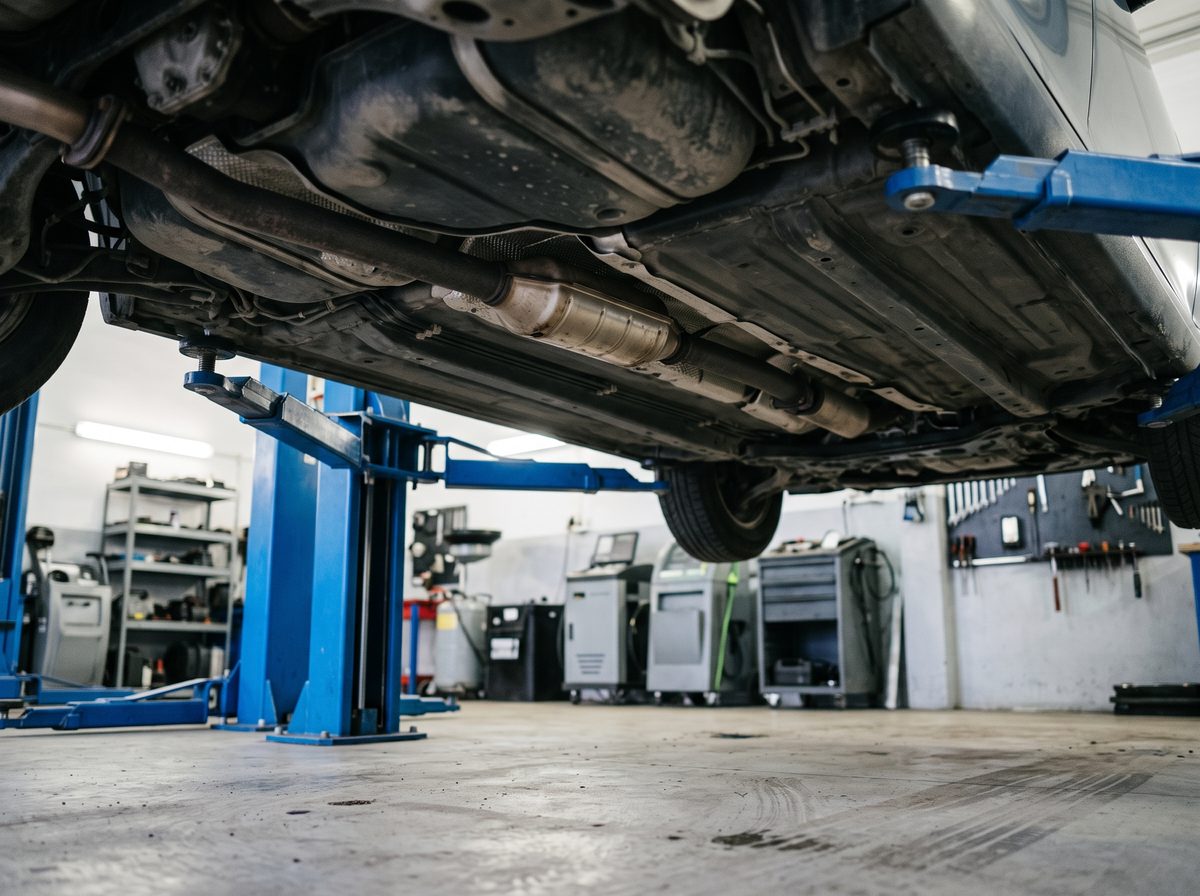
Catalytic Converter Theft
Converters are targeted for the precious metals inside them, and a thief with a battery saw can be gone in under two minutes. Trucks and SUVs sit high enough to slide under, and hybrids like the Prius carry especially valuable units. If your exhaust suddenly roars, this is often why.
Make Sure It's the Right Fix
Before you price the big part, make sure your symptom points here. Two minutes of routing can save you the cost of a part you didn't need.
That code reports a failed efficiency test, not a dead part — and it's set by sensors, leaks, and misfires just as often as by a worn converter. Our full P0420 guide walks through every cause before you buy anything.
P0420 Code ExplainedStart with a full-module scan and road test. We read every code, show you what they say, and tell you plainly whether the exhaust, the engine, or a sensor is the story.
Check Engine DiagnosticsA blown gasket, a rusted pipe, or a bad muffler makes noise without touching the converter. That's general exhaust work — a different, usually smaller fix.
Exhaust & Muffler RepairA precious-metal part carries a real price. Snap and Synchrony financing can spread an approved repair into payments arranged before the work starts.
Financing OptionsHow We Take the Risk Out
A converter is a big-ticket repair. These are the terms that come with every one we do.
We prove the converter has failed — and find what caused it — before you buy a new one.
Whatever we install is the correct, inspection-legal converter for your vehicle. No exceptions.
The findings and the numbers on paper, approved by you, before any work begins.
Snap Finance and Synchrony Car Care — 6-month promotional financing on approved credit.
On a repair this size, the reviews that matter most are the ones about diagnosis and straight answers — the fault found, the fix explained, the price fair. That's three decades of not selling parts people didn't need, from an ASE-certified, ATRA member shop.
Converter FAQ
Often, no — not until testing proves it. A P0420 code and even a rotten-egg smell can come from a worn oxygen sensor, an exhaust leak, or a misfire, and each costs a fraction of a converter. We watch both O2 sensors live and test the converter itself before condemning it, so you only buy the part you actually need.
It has one of the widest ranges in auto repair, because the converter's precious-metal core makes it an expensive part and no two vehicles are alike. Your make and emissions rules, whether the engine runs one converter or two, the oxygen sensors, and the upstream repair that caused the failure all move the number. We won't guess it over the phone — you get a written estimate after diagnosis, and financing is available on approved credit.
Because something upstream killed the first one and never got fixed. A misfire dumping raw fuel, a rich mixture, burning oil, or an exhaust leak will cook or contaminate a new converter just as fast as the old one. Finding and repairing that cause is the difference between buying one converter and buying one every year.
Yes. Converter theft is common in North Texas, and we source and install the correct emissions-legal replacement for your vehicle, with an itemized estimate for your insurance claim. Ask us about deterrents — shields, etching, and where you park — when we have the vehicle in, so it's less of a target next time.
ASE-Certified · ATRA Member · Since 1995
Bring the code, the estimate, or just the light. We'll scan every code, watch the oxygen sensors, and test the converter before anyone replaces it — then put the real fix in a written estimate before any work begins. If it does turn out to be the converter, we source the emissions-legal unit and Snap or Synchrony financing is available on approved credit. Serving Denton, Lewisville, Flower Mound and nearby.