Transmission Fluid Service in Denton, TX · Since 1995
The least expensive service on the most expensive part of your drivetrain. A real fluid service means the pan comes off, a new filter and gasket go in, and the refill is the exact fluid your transmission calls for — not a splash-and-go, and never a one-size 'universal.' Automatics, manuals, CVTs, and diesel units — ASE-certified techs and an ATRA member shop, at it since 1995.
Prefer to talk now? Call (940) 514-8690
Check It Yourself
If your vehicle has a transmission dipstick, pull it with the engine warm and wipe it on a white paper towel. The color is the cheapest diagnostic there is.
Healthy fluid doing its job. Keep up with the interval and glance at it again at your next oil change.
All goodAging and oxidizing. Time to schedule a fluid and filter service — this is the cheap window.
Service dueThe fluid has been running hot and is breaking down. Have it inspected before wear sets in.
Get it checkedBurnt fluid carrying friction material. A simple service may no longer be the fix — inspection first.
Come in nowCoolant is mixing into the transmission — usually a failing cooler line or radiator core. This can't wait.
UrgentNo dipstick? Most late-model transmissions are sealed — level and condition get checked by temperature, with a scan tool, at the shop. We'll read it for you. Not sure what you're seeing? Ask us →
The Big Question
Both put fresh fluid in your transmission. They go about it very differently, and the right one depends on the unit's age, mileage, and service history — not on what's quickest to sell.
| What you're comparing | Our usual first step Drain & fill The pan service | Fluid exchange ("flush") Machine-assisted full swap |
|---|---|---|
| What happens | The pan comes off, the old fluid drains, a new filter and gasket go on, and we refill to the correct level. | A machine swaps fluid while the transmission pumps it through — new fluid pushes the old out of the whole system. |
| How much fluid is replaced | Roughly a third to half — what's sitting in the pan. | Nearly all of it, including the torque converter and cooler lines. |
| Filter & pan inspection | Yes — new filter, and we read the pan and magnet for wear debris. | Not by itself — no pan drop, no filter, no look inside. |
| Gentle on a neglected unit | Yes — an incremental refresh that doesn't stir the pot. | No — we don't recommend it on old, never-serviced fluid. |
| When it's the right call | Routine service, high-mileage units, or the first service in a long time. | A well-maintained transmission due for a complete refresh — ideally after a pan service. |
A shop that quotes a flush without dropping your pan is guessing. The pan and filter tell us what's really going on inside — that's why we start there.
Worth knowing before you buy one
If the fluid is badly burnt, the pan is full of friction material, or the transmission is already slipping, forcing a full exchange through the system can push debris into the valve body and solenoids — which is how a transmission ends up 'dying right after a flush.' On a unit like that, the honest move is an inspection first: pan off, fluid read, and a written estimate for what it actually needs. Sometimes that's a gentle drain and fill; sometimes it's a repair. Never a guess.
The High-Mileage Question
The fluid question we hear most, answered without the folklore.
Fresh fluid makes an old transmission fail.
Fresh fluid doesn't break a healthy transmission. When one quits right after a service, the wear was already there — the new fluid's cleaning action just unmasked it. That's exactly why we inspect before we drain.
The varnish is 'holding it together,' so never touch it.
There's a grain of truth here: badly worn clutches can lean on the friction material floating in old fluid. But varnish isn't glue — the real question is how worn the unit is, and the pan answers that before anyone commits to anything.
My fluid is 'lifetime' — it never needs changing.
'Lifetime' assumes ideal conditions. The same automakers publish severe-service schedules — towing, stop-and-go, sustained heat — that call for service tens of thousands of miles sooner. North Texas summers and traffic are the textbook definition of severe.
It's already slipping — a fluid change will fix it.
Once it slips, worn parts are the cause, and fluid alone rarely cures it. We'll tell you that before we start, so you're choosing between real options — service, repair, or rebuild — with a written estimate for each.
What's Included
Every transmission fluid service here includes the pan, the filter, and a verdict on what we found — the parts a drive-through fluid swap skips.
If the pan tells a different story — heavy debris, burnt fluid — we stop, show you what we found, and put the options in writing before going any further.
How Often?
Owner's manuals publish two schedules — 'normal' and 'severe' — and most Texas driving lands in severe. Find how you drive; that's the schedule that applies.
The easiest life a transmission can live. Fluid still ages with heat and time, so have the condition checked rather than assuming it's fine.
Heat is what kills fluid, and towing makes heat. Manufacturers' severe-service schedules commonly call for transmission service around every 30,000 miles on working trucks.
I-35 traffic, school runs, and delivery routes cycle the transmission constantly — most manuals class this as severe service, not normal.
Don't order a flush off a menu. Start with an inspection and, if the pan checks out, a gentle drain & fill — the safe path back onto a schedule.
Common industry guidance runs roughly every 30,000–60,000 miles under severe service and longer under normal use — but your owner's manual is the authority for your unit, and we'll look your schedule up with you.
Why Here
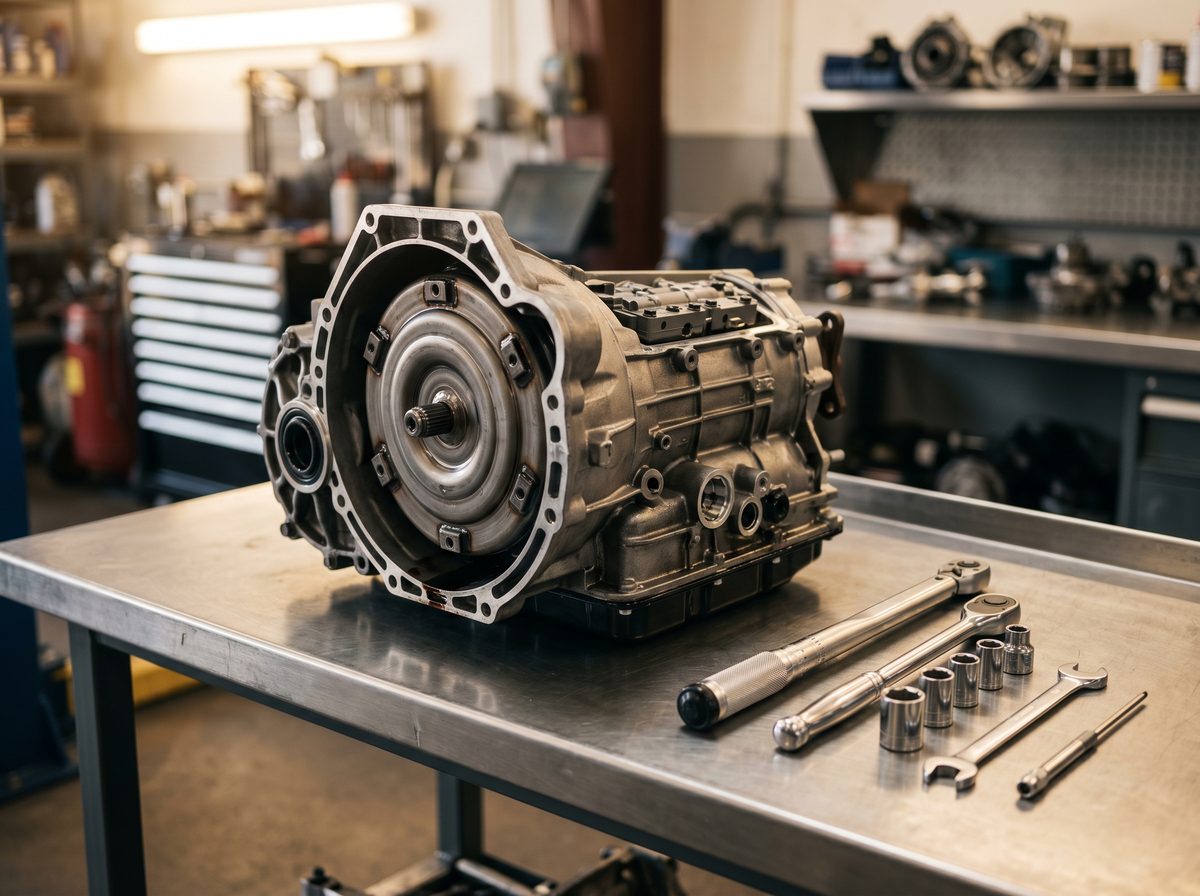
A quick-lube tech sees a drain plug. A transmission shop sees the whole unit. Your fluid service here happens a few feet from our rebuild bench, by the same ASE-certified techs Denton drivers have trusted with complete transmission repair and rebuilds since 1995 — and that changes what you get out of a simple service.
When Fluid Isn't the Fix
Fluid is maintenance. If your transmission is already misbehaving, these pages match the symptom to the right next step.
Those symptoms point to wear inside the unit, and fluid alone rarely cures them. Our transmission repair and rebuild page walks through diagnosis, your options, and the free 20-mile tow on most vehicles.
Transmission Repair & RebuildA howl that rises with road speed often isn't the transmission at all — it's the differential, which runs its own gear oil on its own schedule.
Differential RepairA stored code narrows the search before anyone guesses. A proper scan tells us whether you're looking at a sensor, the engine, or the transmission.
Check Engine DiagnosticsIf the inspection does turn up a major repair, you don't have to pay it in one bite — Snap and Synchrony financing are available on approved credit.
Financing OptionsOften the torque-converter clutch, and often caught at the fluid stage. Our shudder guide explains what you're feeling and when fresh fluid is the fix.
Torque Converter ShudderLow or burnt fluid is the cheapest cause of a slip — our guide walks the rest, cheapest-first.
Why Transmissions SlipIt's the least expensive way to find out how a shop treats you. What reviewers describe afterward is the same pattern: straight answers on the diagnosis, fair pricing, work finished when promised, and warranties that get honored — from daily drivers to diesel trucks and RVs. That's been the standard here since 1995.
Good to Know
It depends on the fluid your transmission requires (some late-model and CVT fluids cost several times more per quart than standard ATF), how many quarts the unit holds, and whether it's a drain & fill or a full exchange. Industry-wide, a basic drain-and-fill generally runs in the low hundreds, with long-capacity and specialty-fluid units running more — but we don't quote blind. You get a written estimate for your exact vehicle before any work begins.
A drain & fill takes the pan off, replaces the filter and gasket, and refreshes the fluid that's in the pan — roughly a third to half of the total. A flush (fluid exchange) uses a machine to swap nearly all of it, including what's in the torque converter. We usually start with the pan service, because it's gentler and it lets us actually see the condition of the unit.
Usually yes, done the right way: an inspection first, then a gentle drain & fill with a new filter — not a forced flush. The stories about transmissions dying after a fluid change almost always involve units that were already worn out inside. If your pan shows that kind of wear, we'll show you what we found and talk through options before anything is drained.
Your owner's manual lists two schedules — 'normal' and 'severe' service — and it pays to be realistic about which column you live in. Towing, hauling, stop-and-go traffic, and sustained Texas heat all count as severe, where manufacturer schedules commonly land around every 30,000–60,000 miles. Give us your year, make, and model and we'll look up your exact schedule.
Most fluid services are an in-and-out visit rather than a multi-day job — typically done the same day. We'll give you a realistic time for your specific vehicle when you book, and we road-test before handing back the keys.
Yes. CVTs get CVT-specific fluid — never conventional ATF — and sealed 'no-dipstick' units are checked and filled by temperature with a scan tool, the way the factory procedure specifies.
We stop and show you — the pan, the fluid, the debris — and put your options in a written estimate before going further. Free local towing up to 20 miles applies on most vehicles, and third-party financing through Snap and Synchrony is available on approved credit.
Denton, TX · Since 1995
A proper fluid service now beats a rebuild later. Call or request a free written quote — the pan, the filter, and the exact fluid your transmission calls for, from the shop that's serviced them since 1995.