4WD & AWD Transfer Case Specialists · Since 1995
Grinding when you shift into 4WD, fluid at the tail of the case, or a driveline that binds in tight turns — that's your transfer case talking. It's the gearbox behind your transmission that splits engine torque between the front and rear axles, and we've been rebuilding them at our Denton, TX shop since 1995. ASE-certified techs, ATRA member, and free local towing up to 20 miles on most vehicles.
Prefer to talk now? Call (940) 514-8690
The 30-Second Education
Every 4WD and most AWD vehicles have one. Here's the path your engine's power takes — and where the transfer case sits in it.
Part-time 4WD locks the front and rear shafts together — great in dirt, mud, and snow, hard on the case when driven on dry pavement. Full-time 4WD and AWD cases add a center differential or clutch coupling so the axles can turn at slightly different speeds year-round.
Symptom Decoder
A failing transfer case rarely goes quietly — it grinds, whines, leaks, and binds first. Match what you're feeling to what it usually means.
Grinding as you shift into or out of 4WD points to a worn mode collar or shift fork, a stretched chain, or fluid running low inside the case.
Get it checkedA whine that climbs as you accelerate usually means the case's bearings are wearing — or the fluid has dropped low enough to starve them.
Get it checkedA leak at the tailhousing or output-shaft seals slowly drains the case. Once the fluid is low, the chain and pump wear fast — and the repair grows with every mile.
Don't waitA clunk on take-off or a ratcheting feel under acceleration in 4WD is the classic sign of a stretched chain jumping teeth.
Don't waitA flashing 4WD light or a range that won't take often traces to the shift motor or encoder — sometimes an electrical fix, sometimes wear inside the case. Diagnosis tells us which.
Get it checkedIf the driveline loads up and hops in a slow, tight turn, read the note below — it's the classic transfer case complaint, and it isn't always a failure.
Read onHearing something that isn't on the list? Describe it when you call — after three decades of drivetrain work, odds are we've heard it before. Diagnosis first, and a written estimate before any wrench turns.
The Classic Complaint
In a tight turn your front wheels travel a longer path than the rears, so the front driveshaft needs to spin slightly faster. A part-time 4WD transfer case locks the two shafts together — on grippy dry pavement that speed difference has nowhere to go, so the driveline winds up until a tire hops or something bangs. That part is physics: shift back to 2WD on dry roads and it should release. But if it binds in 2WD, if an AWD vehicle crow-hops through every corner, or if 4WD refuses to disengage at all, the windup is happening inside a case or coupling that's failing — and every drive grinds the damage deeper. We'll test it and tell you which one you have before anyone talks parts.
Known Failure Patterns
Most transfer case failures follow a handful of well-documented patterns. Because we tear down and rebuild in-house, we replace the parts that wear — not the whole unit on a hunch.
The drive chain elongates over tens of thousands of miles until it slaps the case, then jumps teeth under load. That ratcheting clunk in 4WD is the tell.
On some popular 4x4 trucks the internal oil pump slowly wears against the rear case half — and can eventually wear a pinhole through it. Fluid escapes, the case starves, and the first warning is often a small leak or a growl.
The parts that move the case between 2-Hi, 4-Hi, and 4-Lo. Worn fork pads and a rounded collar are behind most grind-into-gear and stuck-in-range complaints.
Output-shaft seals weep, bearings whine, and old fluid loses its protection. Caught early, a fluid service and reseal costs a fraction of a rebuild.
The Big Decision
When a transfer case is badly worn, there are two realistic paths. Here's the comparison we walk every owner through.
The gamble
Rebuilt to spec, warrantied
Either path starts the same way: diagnosis and a written estimate, so you're choosing with real numbers. And if the estimate lands heavier than the month allows, financing through Snap and Synchrony can spread a major repair into payments.
Built for Truck Owners
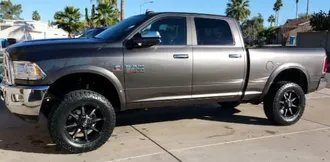
Most transfer case work rolls in bolted to a working truck — half-tons and HDs that tow, haul, and see real ranch-road miles. Since 1995 the same techs rebuilding the transmissions have rebuilt the cases behind them, so the whole driveline gets diagnosed under one roof.
What to Expect
A transfer case complaint gets the same discipline as every drivetrain job here: prove the cause, price it in writing, fix what's actually wrong.
We drive it, work the ranges, listen, and pull the fluid — level, color, and metal in the oil tell half the story before anything comes apart.
Scan the shift motor and encoder for codes, and isolate case noise from transmission and differential noise, so the right part gets the blame.
You get the diagnosis and the price in writing — repair, rebuild, or the rare case where a swap makes more sense — before any work begins.
Torn down and rebuilt in-house with new wear parts, filled with the correct fluid, road-tested in every range, and backed by our warranty.
Not Sure It's the Transfer Case?
Transmission, transfer case, and differential sit inches apart and share one driveline — and their symptoms overlap. Start where yours points.
Slipping, harsh shifts, or delayed engagement that happens in plain 2WD points upstream to the transmission itself — start at the transmission repair and rebuild page.
Transmission Repair & RebuildA howl that lives at an axle — louder under acceleration, changing through turns — is differential territory. The differential guide decodes it noise by noise.
Differential RepairIf the grind, clunk, or bind only shows up when four-wheel drive is engaged, the transfer case is the prime suspect — tell us what you're feeling and we'll take it from there.
Get a Free QuoteOn 2WD or on-road, a driveline vibration is usually the driveshaft/U-joints.
Driveshaft RepairAWD front half-shaft clicking is a CV axle job.
CV Axle ReplacementLess Risk in a Big Repair
A transfer case job is major drivetrain work. These are the guarantees standing behind it.
If it won't drive, don't force it — towing is free up to 20 miles on most vehicles, covering our whole North Texas service area.
See the coverage mapSnap Finance and Synchrony Car Care offer promotional financing on approved credit, so a rebuild can become a monthly payment instead of a bad day.
Explore financing optionsEvery rebuild leaves with a warranty from the shop that did the work — and we honor eligible extended warranties too.
Get a Free QuoteDiagnosis and price on paper before any teardown. You approve the work — nothing starts on a verbal maybe.
Start with a quoteGoogle reviewers keep landing on the same themes: truck and 4x4 drivetrain work done right, diagnoses that don't invent problems, warranties that actually get honored, and the free tow that got them here. Since 1995, under the same roof on Dallas Drive in Denton.
Good to Know
It depends on what's failed and what the case is bolted to — a reseal and fluid service costs a fraction of a chain-and-bearing rebuild, and electronically shifted cases add parts a manual lever doesn't have. We diagnose first and put a written estimate in your hands before any work begins, so you're deciding with real numbers instead of a guess.
It's a gamble. A leaking case can run itself dry in surprisingly few miles, a stretched chain can let go under load, and a seized case can stop the whole driveline. If yours is grinding, binding, or leaking, have it looked at — and if it isn't safe to drive, towing is free up to 20 miles on most vehicles.
As general guidance, every 30,000–60,000 miles for normal driving, closer to every 30,000 if you tow or go off-road, and any time the case has been through deep water. Your owner's manual is the final word for your specific vehicle — and many cases take a specific fluid, so the right type matters as much as the interval.
Usually rebuild. A used case from a salvage yard carries unknown mileage and often the same wear that killed yours, with little warranty behind it. A rebuild replaces the actual wear parts — chain, bearings, seals — and leaves with our warranty. When a case really is damaged beyond saving, we'll say so and quote the alternative.
Common causes are a worn mode collar or shift fork, a stretched chain, low fluid, or engaging at the wrong speed for your system. Some trucks want you rolling slowly and straight; others want a full stop. If it grinds even when you're doing it by the book, the wear is inside the case and worth catching early.
If it only happens with part-time 4WD engaged on dry pavement, that's driveline windup — normal physics, and your cue to shift back to 2WD. If it binds in 2WD, hops in an AWD vehicle, or won't release when you shift out of 4WD, something inside the case or coupling is failing and needs to be looked at.
Yes — part-time and full-time 4WD cases, electronically shifted units, and the AWD transfer cases and couplings behind them, on trucks, SUVs, and crossovers, gas and diesel, foreign and domestic.
Since 1995 · Denton, TX
Call now or send the symptom through the quote form — straight answers, drivetrain work done by the numbers, and warranty-backed rebuilds from the shop North Texas trucks have trusted since 1995.