Engine Repair · Denton, TX · Since 1995
Told you need a head gasket? It's one of the most expensive guesses in auto repair — so before we quote a teardown, we prove it. White smoke, an engine that overheats, milky oil, coolant that vanishes with no puddle: those point at a head gasket, they don't confirm one. Since 1995 we've settled that question with a combustion-gas block test, a cooling-system pressure test, and a cylinder leak-down — then put the fix in writing. ASE-certified techs, ATRA member shop.
Prefer to call? (940) 514-8690
From the Driver's Seat
A head gasket seals combustion, coolant, and oil where they run side by side inside the engine. When it fails, those systems start mixing — and the car tells on it in a handful of ways.
Coolant is being drawn into a cylinder and burned. Thick, sweet-smelling white smoke that doesn't clear once the engine's warm is one of the clearest signs of a breach into the combustion chamber.
Combustion gases pushed into the cooling system create pressure and hot spots the radiator can't shed. If it overheats but never leaves a puddle, the coolant may be going somewhere it shouldn't.
Coolant and oil are mixing. A tan, frothy film under the oil cap or on the dipstick means the two are meeting inside the engine — and driving on that oil damages bearings fast.
If the reservoir keeps dropping and nothing shows under the car, the coolant is being burned or routed into the oil. That's an internal path, not a hose or a clamp.
Exhaust gases forced into the coolant show up as bubbles rising in the reservoir or radiator neck. It's the same evidence a block test measures — you're seeing combustion in the wrong place.
A breach between two cylinders, or into the cooling jacket, can leave the engine stumbling until it warms and the metal expands to seal. A stored misfire code often rides along.
Every one of these can also come from something cheaper — a radiator, a thermostat, a leaking cooler, even cold-morning condensation. That overlap is exactly why we test before we quote.
Before You Drive It Again
Driving on a blown head gasket — or an engine that keeps overheating — is how a repair becomes a replacement. Heat warps the aluminum cylinder head, a warped head can crack, and keep going and you can score a cylinder or crack the block itself. If the temperature gauge is climbing or you see white smoke, shut it down and call. We'll tell you whether it's safe to drive in or better to arrange a tow.
Get It DiagnosedVerify, Don't Guess
A head gasket job is one of the biggest guesses in auto repair, so we don't guess. Since 1995 the same tests run before we quote, in this order.
We pull the codes — misfires, cooling faults — read live data, and see how the engine behaves warm. Some "head gaskets" turn out to be a thermostat or a sensor, and that's where it shows.
We pressurize the system cold and watch where it goes. A gasket leak often bleeds pressure into a cylinder or the oil rather than onto the ground — the pressure gauge catches what your eyes can't.
The one that settles it. A chemical block tester checks the coolant for combustion gases; if exhaust is getting into your coolant, the test fluid changes color — direct evidence of a breach, no teardown required.
We measure each cylinder and listen for where the air escapes — into the coolant, the crankcase, or the neighboring cylinder. That pinpoints the leak and rules out worse damage before any parts are quoted.
Only once the tests agree do we put the scope and the number in writing. You see it and approve it before anything comes apart — never a verbal maybe.
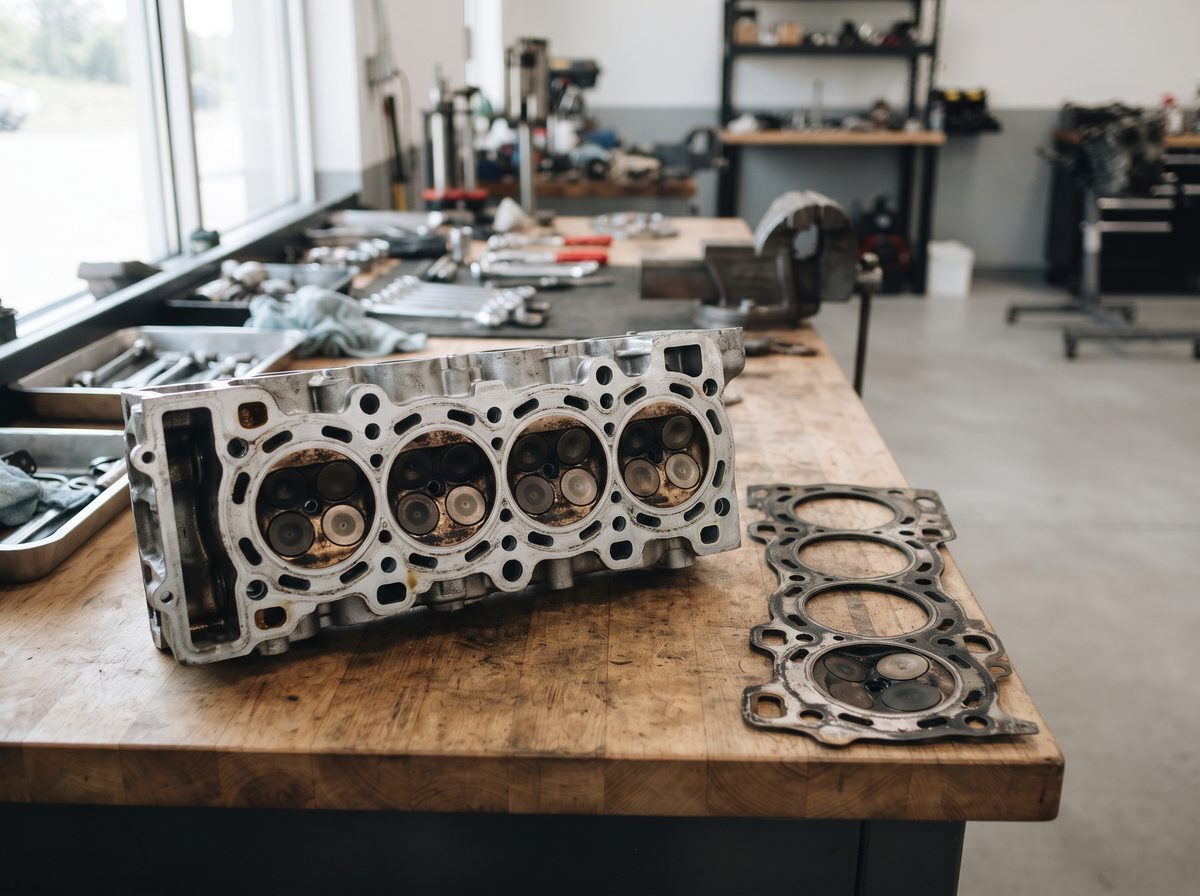
With the head off, we inspect it for warpage and cracks and check the block deck. A proper repair requires the head to be flat and the cause of the failure fixed — not just a fresh gasket on an old problem.
What a Real Repair Includes
The gasket itself is a cheap part. What makes the repair last is everything around it — and skipping those steps is why some head gasket jobs come back within a year.
Heat warps aluminum. A proper job checks the head for flatness and cracks and has it resurfaced if it's warped; bolting a new gasket to a warped head just fails again.
A head gasket rarely dies on its own. Usually something let the engine overheat — a thermostat, water pump, fan, or radiator. Fix the gasket without fixing the cause and you're back.
Many engines use torque-to-yield bolts that stretch on install and can't be safely reused. New bolts, torqued in the right sequence, are what hold the seal.
Fresh coolant, and often the timing components and gaskets that have to come off anyway, are handled in the same job — because doing them twice costs you twice.
Before You Spend
Straight answers on the shortcuts and the scare tactics.
A bottle of head-gasket sealer will fix it.
Sealer can sometimes buy time on a tiny seep, but it can't flatten a warped head or reseal a real breach — and it can clog a radiator or heater core on the way. On a confirmed head gasket it usually trades one repair bill for a bigger one.
White smoke means the head gasket's gone — start there.
Sweet-smelling white smoke points at coolant burning, but the same look can come from a cracked intake, a failed oil cooler, or just cold-morning condensation. A block test tells you whether combustion gas is really in the coolant before anyone pulls a head.
If it's the head gasket, the engine's junk — replace the car.
Caught early, a head gasket is a repair, not a funeral. Whether a reseal or a used or remanufactured engine is the smarter money depends on the miles, the damage the overheating did, and the vehicle's value — we lay out the real numbers instead of steering you to the biggest ticket.
The theme in every row: confirm the problem, then spend on the fix that actually solves it.
The Decision
When the tests come back positive, the real question is whether the engine is worth saving. Here's the comparison we'd run on our own vehicle.
| Usually the smart money Head gasket repair Reseal it, save the engine | Used engine A running engine from a salvage vehicle | Reman / new engine A rebuilt or new long block | |
|---|---|---|---|
| What you get | Your own engine, resealed, with the cause of the failure fixed | Another vehicle's engine, sold as-pulled with unknown history | A professionally rebuilt or new engine assembly |
| Relative cost | $$ — the lowest of the three when the engine is otherwise sound | $$ — a cheaper part, but the same installation labor either way | $$$ — the highest ticket by far |
| Best when | Caught early, before overheating scored a cylinder or cracked the block | The block or head is damaged beyond repair on an older vehicle | The engine is worn out or badly damaged and you're keeping the vehicle for years |
| The risk | If the overheating already hurt internals, a reseal alone won't hold — the tests tell us first | Unknown miles and often a short, parts-only warranty; if it fails, the labor's on you again | On an older car the cost can approach what the vehicle is worth |
| Warranty | Backed by the shop that did the work | Often short and parts-only | Manufacturer or rebuilder terms |
The block test and the teardown tell us which column you're really in — before you commit a dollar. When a reseal is enough, we won't sell you an engine.
What It Costs
A head gasket job is mostly labor — the gasket is a small part buried under half the engine — so the estimate swings on how deep the work goes. These are the levers, and yours goes in writing before any teardown.
Engine layout
A transverse V6 packed into a tight bay takes far more hours to open than an inline-four with room to work — the single biggest swing on the estimate.
How far the overheating went
A gasket caught early is a clean job. One driven hot can warp the head or damage a cylinder, and that turns a repair into a bigger one — which the tests find before you're surprised by it.
Head machining
If the head is warped it has to be resurfaced, and if it cracked it may need repair or replacement — machine work and parts on top of the gasket set.
Parts that have to come off anyway
Timing components, the water pump, and gaskets exposed during the job are smart to renew while the engine's open — a little more now instead of paying the labor twice.
The underlying cause
The thermostat, water pump, fan, or radiator that let it overheat gets fixed too, so the new gasket isn't set up to fail again.
Industry-wide, a proper head gasket repair commonly runs well into four figures because of the labor involved — which is exactly why we confirm it first and put the scope in writing. Diagnosis first, then a written estimate you approve before teardown; if the inspection changes the scope, you hear it from us before anything proceeds.
How We Take the Risk Out
An engine repair is a big ticket. These come standard with ours.
A block test and leak-down prove it's the head gasket before you approve teardown — no paying just to find out.
The scope and the number on paper, approved by you, before anything comes apart.
Every repair is backed by the shop that did it — ASE-certified techs, ATRA member, since 1995.
Snap Finance and Synchrony Car Care — 6-month promotional financing on approved credit.
On a job this size, the reviews that matter most are the ones about honesty — diagnostics that found the real problem, no upsell to a bigger repair than the car needed, and fair pricing where padding would have been easy. Three decades of that is the reputation an engine repair deserves. ASE-certified technicians, ATRA member.
Head Gasket FAQ
We don't assume — we test. A cooling-system pressure test, a combustion-gas block test that checks your coolant for exhaust gases, and a compression or cylinder leak-down test together confirm a breach and locate it before we quote a teardown. Some "head gaskets" turn out to be a thermostat, a hose, or a cooler — and that's a far smaller bill.
It's risky. A leaking head gasket lets coolant and combustion gases go where they shouldn't, and continued overheating can warp the head or crack the block — turning a repair into an engine replacement. If it's overheating or blowing white smoke, stop driving and call us; we'll tell you whether it's safe to bring in or better to arrange a tow.
Rarely for long. Sealer can sometimes slow a tiny seep, but it can't flatten a warped head or reseal a real breach, and it can clog a radiator or heater core on the way. On a confirmed head gasket it usually just delays the real repair — and can add to it.
There's no single flat number, because the job is mostly labor and depends on the engine, how far the overheating went, and whether the head needs machine work. Industry-wide it commonly runs well into four figures. We diagnose first, then put an exact figure in a written estimate you approve before any teardown — and financing through Snap and Synchrony is available on approved credit.
Usually the repair is the smart money — if the engine is otherwise sound and the overheating didn't already damage it. The block test and teardown tell us which is true. When a reseal will hold, that's what we recommend; when the block or head is damaged beyond saving, we'll show you the numbers on a used or remanufactured engine instead of guessing.
ASE-Certified · ATRA Member · Since 1995
One call gets you a real diagnosis — a block test that proves it, a plain-English explanation, and a free written estimate before any teardown. Repair or replace, we'll show you the real numbers and stand behind the work. Serving Denton, Lewisville, Flower Mound and nearby.