Interference-Engine Stakes · Denton, TX · Since 1995
Your timing belt is the one part with a due date you don't get to negotiate. On most modern engines it's an interference design — when a worn belt lets go, the pistons meet open valves and a routine maintenance job becomes a bent-valve teardown in a single second. Since 1995 our ASE-certified techs have replaced belts on the manufacturer's schedule — the full kit, the water pump where the belt drives it, and the engine re-timed and verified — so you never find out the hard way whether yours is an interference engine.
Prefer to call? (940) 514-8690
The One Interval You Never Skip
There's no dashboard light for a tired timing belt and no limp-home mode. It's rubber, and rubber ages on heat, oil, and miles whether you drive the car or not. On an interference engine — most of what's on the road today — the valves and pistons pass through the same space at different moments, kept apart only by that belt. Break the timing and they collide: bent valves at best, a scored head or piston at worst. That's why a belt is replaced on a schedule, not on a symptom — because the failure and the repair bill arrive in the same instant.
Check My Belt's IntervalIf You're Waiting For a Sign
A timing belt usually fails without a courtesy. A few tells can show up, and they're worth knowing — but the plain truth is that the interval, not the symptom, is what protects your engine.
A belt going slack can tick against its covers or a worn tensioner. It's worth a look now — but plenty of belts snap without ever making a sound first.
If the belt has already broken, the camshaft stops turning while the starter spins the crank freely — a fast, hollow crank with no start. On an interference engine, stop cranking: every turn can drive a piston into an open valve.
A weeping cam or crank seal soaks the belt in oil, and oil eats rubber. A belt swimming in a leak won't reach its interval — the leak gets fixed as part of the job.
When the belt has jumped a tooth, the camshaft and crankshaft fall out of sync and the computer flags it. That's a timing problem asking to be read before it becomes a broken one.
This is the normal case, and the best one. A belt at or past its replacement interval is due regardless of how it feels. Catching it here is the whole difference between a maintenance ticket and an engine bill.
Whatever it's doing — or not doing — the surest answer is your engine's published interval. Send your year, make, and model and we'll tell you where yours stands.
First Question
They do the same job — keep the valves and pistons in sync — but they're maintained completely differently, and half the confusion around "timing belt" is not knowing which one your engine runs. Here's the straight version.
| Interval part Timing belt Rubber, driven inside a cover | Timing chain Metal, oiled inside the engine | |
|---|---|---|
| What it's made of | Reinforced rubber with fiber cords — quiet and light, and it wears with age and heat | Steel links running in engine oil, like a bicycle chain |
| Needs scheduled replacement? | Yes — that's the whole point. Replaced at a set mileage or time, whichever comes first | Not on a fixed schedule — built to last, but not immortal (see below) |
| Typical interval | Commonly in the 60,000–105,000-mile range by manufacturer — always confirm yours by year and model | No belt-style interval; clean oil changed on time is what keeps it healthy |
| How it warns you | Rarely — which is exactly why it's replaced on schedule, not on symptoms | A rattle on cold start or a timing code as the chain, guides, or tensioner wear |
| What failure looks like | Sudden — and on an interference engine, valve damage in the same second | Usually gradual — a stretching chain throws a correlation code before it lets go |
| What to do | Replace it before the interval — that's this page | Get the rattle or code diagnosed — that's engine-timing work, not a belt job |
Not sure which you have? Your year, make, and model settles it in a minute — call or send it with the form and we'll tell you, no upsell either way.
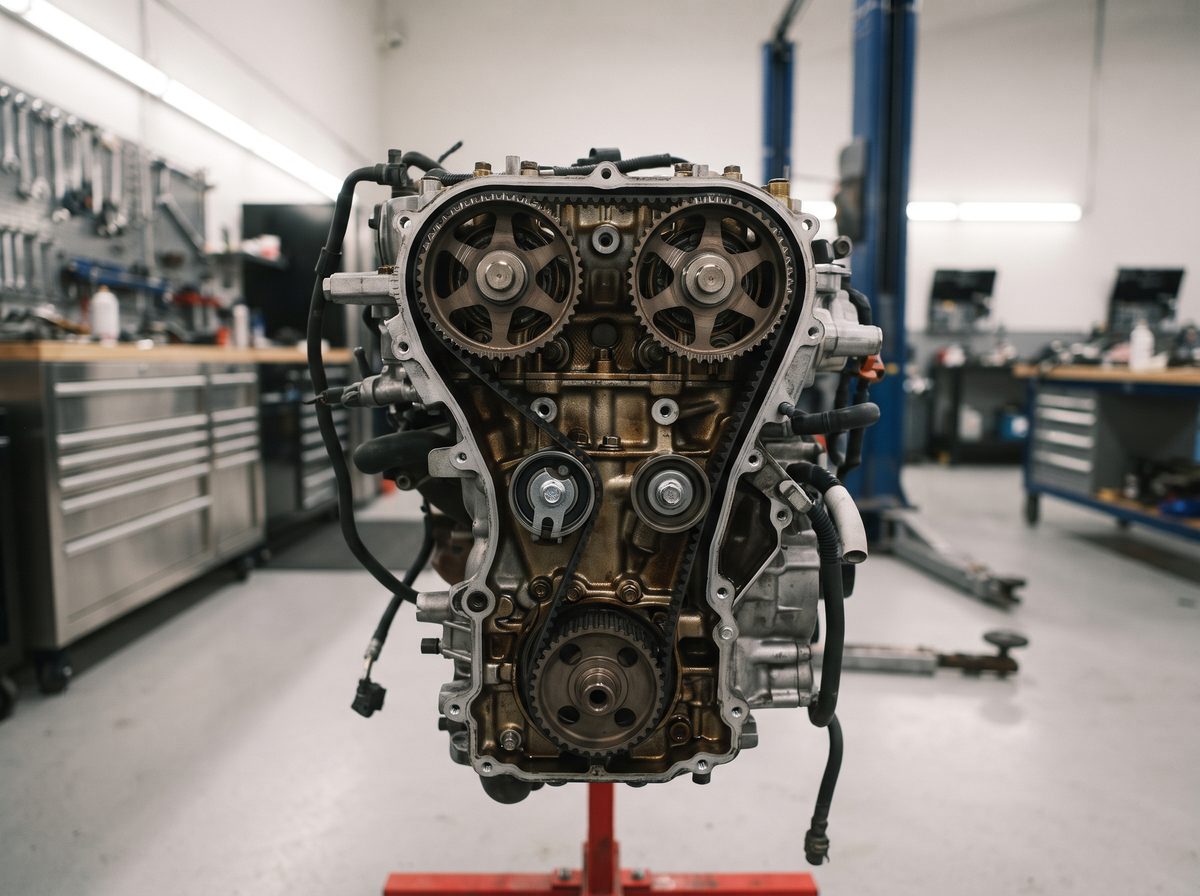
Not Just a Belt
Reaching the belt means opening the front of the engine — covers, accessory belt, mounts, sometimes the crank pulley. Once you're in there, swapping the belt alone and buttoning it back up is how a shop leaves money on your ticket for later. A real job renews everything that lives in that space and wears on the same clock.
The wear part itself — matched to your engine and set into exact time with the crankshaft and camshafts.
The bearings that hold and guide the belt age right alongside it. A seized idler can shred a brand-new belt, so they go in as a set.
If a seal is weeping, oil is already reaching the belt. With the covers off, replacing the seals costs pennies in labor now versus a full teardown later.
On many engines the timing belt spins the water pump, buried in the same space. Replacing it now is the smart move — the next section explains why.
If the pump comes out, the system is refilled to your engine's exact coolant spec, with new gaskets — never the old ones reused.
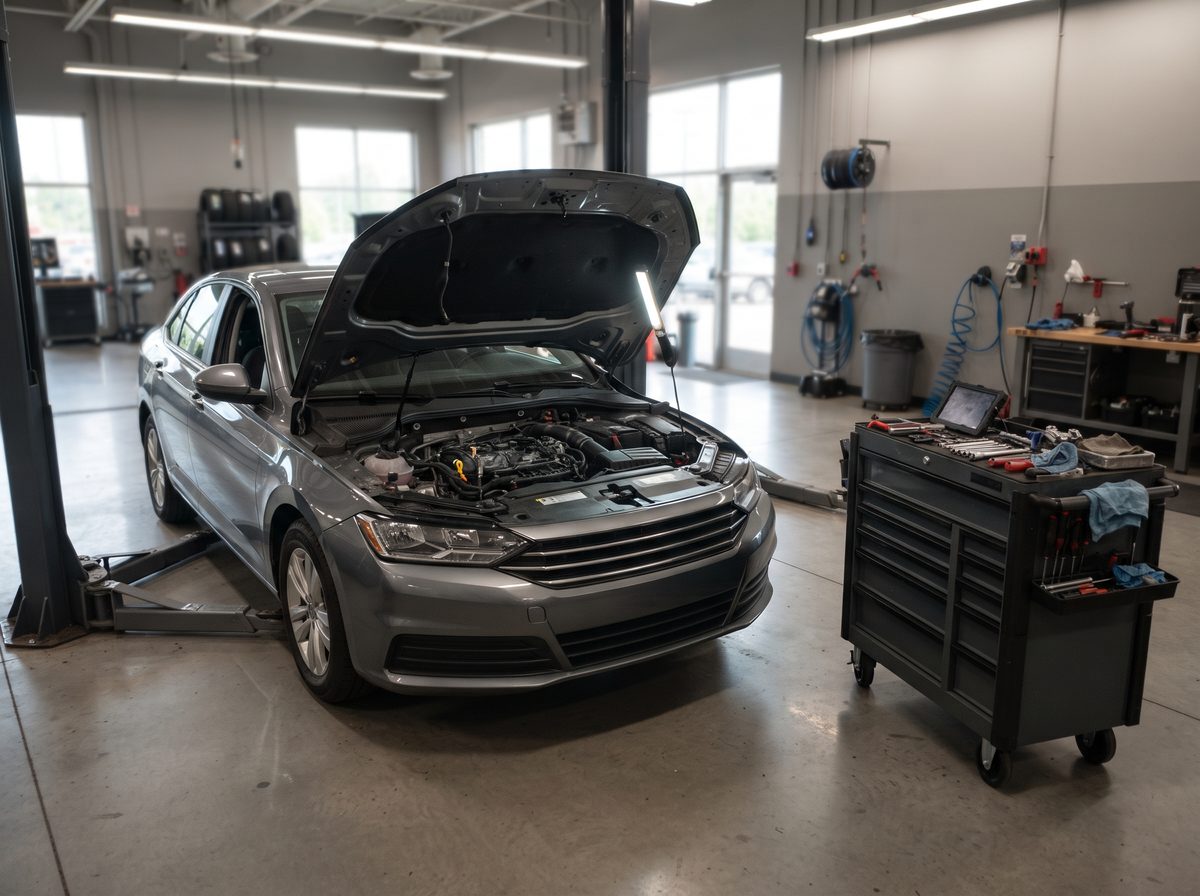
The Honest Bundle
On a belt-driven water pump, the pump sits behind the same covers, turned by the same belt. Nearly all the cost in a water-pump job is getting to it — and on these engines the timing belt job already paid for that access. Skipping the pump to save a part today is how you end up paying the whole teardown twice.
How We Do It Right
The phrase gets used loosely. Here's the sequence a timing belt job runs through on our bench — every engine, since 1995.
We verify your engine's published belt interval by year and model, and whether it's an interference design — so you know exactly what's due and what's at stake.
The full scope — belt, tensioner, idlers, seals, and the water pump when the belt drives it — priced and approved by you before a bolt is turned.
The crank and cams are brought to their factory reference points and locked, so the new belt goes on in exact time — the step that separates a real job from a guess.
New belt, new tensioner and idlers, fresh seals, and the water pump where it's belt-driven — the whole front of the engine renewed, not just the one rubber part.
Correct-spec coolant if the pump was in the job, timing double-checked by hand rotation, then a scan for correlation and a road test before it leaves the shop.
You leave with the work documented and warranty-backed — and a straight answer on when the next interval comes due.
What It Costs
Timing belt prices swing more than almost any maintenance job, because the labor to reach the belt is wildly different from one engine to the next. These are the levers that move your estimate — and yours goes in writing before any work begins.
Engine layout & labor hours
A transverse V6 wedged in sideways can be a half-day teardown; a roomy inline-four is far quicker. Access is the single biggest cost, and it's set by your engine.
How much goes in the kit
Belt alone, or belt with tensioner, idlers, and seals. We quote the full kit, because a partial job is a repeat job.
Water pump, when it's belt-driven
If the belt spins the pump, bundling it adds the part but almost none of the labor — the cost-smart moment to replace it.
Interference vs. non-interference
It doesn't change the belt price, but it changes the stakes of waiting — and whether a related repair is already overdue.
What we find once it's open
A weeping seal, a failing tensioner, or a pump already leaking gets caught with the covers off. We call you before adding anything — never on the final bill.
Interval check and diagnosis first, then a written estimate you approve before any work. If we find something with the covers off, you hear it from us before it's touched.
Built-In Protection
A timing belt is preventive work with no visible result. These come standard so you can trust it was done right.
The full kit and scope on paper, approved by you, before the engine is opened.
The job is documented and stands behind a warranty — and we honor eligible extended warranties too.
Belt, pump, and coolant matched to your engine's specification — never a universal substitute.
Snap Finance and Synchrony Car Care — 6-month promotional financing on approved credit.
Drivers keep leaving the same notes: diagnostics that found the real problem, the job done right, warranties honored without a fight, and fair prices where padding would have been easy. Three decades of that — ASE-certified technicians, ATRA member — is the reputation a job you can't see deserves.
Timing Belt FAQ
It comes down to your exact engine, not just the make. Many newer engines use a chain that isn't on a replacement schedule; plenty of others — and most engines a decade or more old — use a rubber belt that must be replaced on an interval. Give us your year, make, and model and we'll tell you which you have and where it stands, with no obligation.
On an interference engine — most of what's on the road — the pistons and valves share the same space, and the belt is what keeps them from meeting. If it snaps, they collide: bent valves, and sometimes worse. The car stalls and won't restart, and cranking it only does more damage. That's the whole reason a belt is replaced on schedule instead of driven to failure.
On engines where the timing belt drives the water pump, yes — it's the cost-smart call, and the one we'd make on our own vehicle. Almost all the labor is getting to that space, and the belt job already pays for it; adding the pump now is mostly the cost of the part. If your pump isn't belt-driven and isn't in the way, we'll tell you that and leave it alone. Either way it's spelled out in your written estimate.
There's no flat number, because the labor to reach the belt varies enormously from one engine to the next — some are a couple of hours, some are a half-day. What goes in the kit and whether the water pump is bundled matter too. We check your engine, then put an exact figure in writing before any work begins. Financing through Snap and Synchrony is available on approved credit.
ASE-Certified · ATRA Member · Since 1995
Tell us your year, make, and model and we'll confirm your interval, whether it's an interference engine, and exactly what the job needs — the full kit, the water pump where it counts, and a written estimate before any work begins. Serving Denton, Lewisville, Flower Mound and nearby.