Engine Repair · Denton, TX · Since 1995
One long belt drives almost everything on the front of your engine: the alternator that charges the battery, the water pump that cools it, your power steering, and the A/C. The belt is a cheap part — but a proper job replaces the worn tensioner and idler pulleys that kill belts early and finds why yours wore, so the new one lasts. Since 1995, Eagle's ASE-certified techs do it right the first time. Written estimate before any work.
Prefer to call? (940) 514-8690
Why a worn belt isn't a "later" job
On most vehicles a single serpentine belt drives the alternator, the water pump, the power steering pump, and the A/C compressor. When a worn belt lets go — and they usually let go without much warning, far from home — the battery light comes on, the steering goes heavy, and on many engines the water pump stops turning and the temperature starts climbing within minutes. A ten-dollar part becomes a tow and an overheat. That's why a cracked or squealing belt is a this-week job, not a someday one.
Get It Looked AtCatch It Before It Strands You
A serpentine belt gives you warning before it fails — if you know what you're hearing and seeing. Any of these is worth a quick look before it becomes a roadside call.
A glazed or slipping belt squeals loudest when it's cold or under load — like a hard steering turn. It's the belt telling you it's losing its grip on the pulleys.
A rhythmic chirp is often a misaligned belt or a failing idler-pulley bearing, not the belt itself. Either way it's the drive wearing — and pulleys seize.
Look at the ribbed side: fine cracks across the ribs, a shiny glazed surface, or frayed edges all mean the rubber is done. Belts don't get better.
If the belt is slipping, the alternator and power-steering pump it drives don't get full speed — so the charging light flickers and the wheel gets heavy. That's the belt starting to give up.
Fine black dust collecting near the belt path is shed rubber — a sign of misalignment or a hardening belt grinding itself away.
A snapped belt means no charging, no power steering, and on many engines no water pump — pull over before the temperature climbs, and call for a tow.
Not sure if it's the belt or something it drives? That's exactly the kind of thing we sort out in a few minutes — before you replace the wrong part.
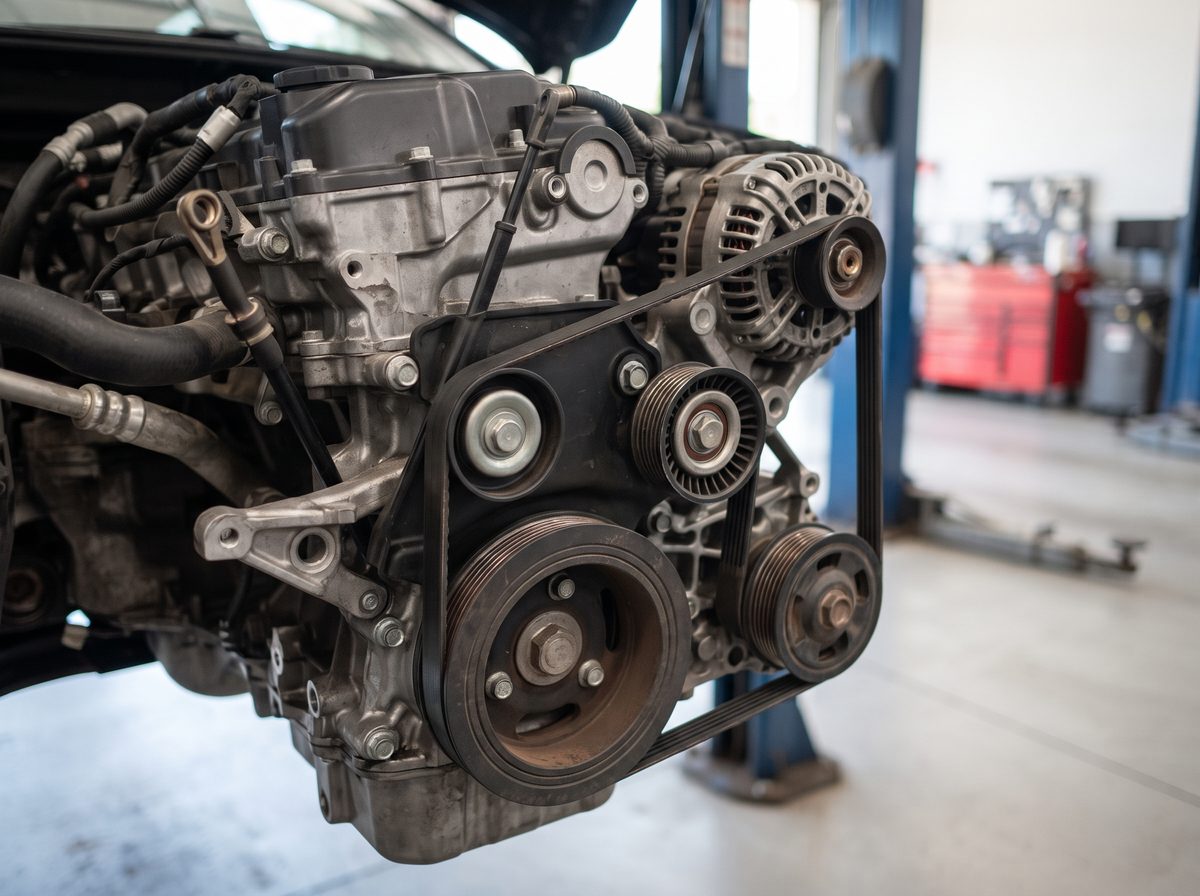
More Than a Belt
The belt is the cheap, visible part. What makes the repair actually last is everything it rides on — and skipping those is why some belt jobs squeal again within a year.
A new ribbed belt, matched exactly to your engine and routed correctly around every pulley. Routing matters: one wrong loop and it won't drive an accessory.
A spring-loaded arm keeps the belt tight. When it weakens, it lets a brand-new belt slip and squeal and wear out early. On a high-mileage engine, replacing it with the belt is what makes the fix hold.
The smooth pulleys the belt wraps ride on bearings. Worn ones chirp, then seize — and a seized pulley can throw a fresh belt. We check them while we're in there.
A belt that failed early usually had help: a leaking seal dripping oil onto it, a misaligned pulley, or a dragging accessory. We find that, so the new belt isn't set up to fail again.
How We Do It
It's a quick service done carelessly and a reliable one done right. Here's the order we work in.
Not just the belt — the tensioner's travel and spring, every idler-pulley bearing, and the accessories the belt turns. That's where the real cause usually hides.
A leaking seal dripping oil on the belt, a misaligned pulley, a dragging alternator or A/C clutch — we identify it, because a new belt on an old problem just fails again.
We fit the correct belt and, when they're worn, the tensioner and idler pulleys as a set. You approve the scope in writing first; if the belt alone is enough, we say so.
The belt is threaded exactly to the routing diagram and the tensioner sets the tension automatically — we confirm both, because a mis-routed belt won't drive an accessory.
We start it, check that it's quiet, confirm the charging system and accessories are all turning, and make sure the fix left no new noise behind.
What It Costs
The belt is inexpensive; the estimate swings on access and how much of the drive is due. These are the levers, and yours goes in writing before any work.
Engine access
Some engines put the belt right up front — a quick job. Others bury it behind a motor mount or the accessories, which adds labor to reach it.
Tensioner & idlers
Belt-only is the cheapest ticket, but on a high-mileage engine a worn tensioner or idler done with the belt is what makes the repair last — a little more now instead of a repeat visit.
Belt length & type
A long multi-rib belt on a big V8 costs a bit more than a short four-cylinder belt, but the part itself is rarely the big number.
The underlying cause
If a leaking seal or a dragging accessory wore the belt out, fixing that is part of a repair that holds — and we lay it out before you decide.
No fixed number over the phone — we look at your vehicle, tell you whether the belt alone is enough or the drive needs more, and put it in a written estimate before any work.
A belt squeal is easy to silence with a cheap belt and send you on your way. The reviews that matter are the ones about shops that found why it wore and fixed it — straight answers, fair prices, and work that held. Three decades of that in Denton. ASE-certified, ATRA member, and women-owned.
Serpentine belt questions
No — and it's an important difference. The serpentine belt is on the outside of the engine and drives your accessories: alternator, water pump, power steering, and A/C. The timing belt is inside, and it keeps the engine's valves and pistons in sync. They wear differently and cost differently. If you're not sure which you were quoted, we'll tell you which one your car actually has and needs.
Modern belts last a long time — often somewhere in the 60,000 to 100,000-mile range — but they're replaced by condition as much as mileage. Cracks, glazing, fraying, or a chirp on cold start are the real signals. We inspect the belt, the tensioner, and the idler pulleys together, because a tired tensioner is what kills a lot of belts early.
Not for long. That belt runs your charging, cooling, and steering. If it snaps — and worn belts snap without much warning, usually far from home — the battery light comes on, the steering goes heavy, and on many engines the water pump stops and the temperature climbs within minutes. A squeal or chirp is your cue to have it looked at now, not after it strands you.
We can, but on a high-mileage engine it's often false economy. The tensioner is a spring-loaded arm that keeps the belt tight; when it weakens, it lets the new belt slip, squeal, and wear out early. The idler pulleys ride on bearings that whine and seize. If they're worn, replacing them with the belt is what makes the repair last — and we'll show you why on your vehicle rather than just selling the kit.
A squeal on start-up or when you turn the wheel is often a glazed or slipping serpentine belt; a chirp that comes and goes is frequently a misaligned or failing pulley bearing. Both are the belt drive telling on itself. We can pin down which it is quickly — the fix is far cheaper than the breakdown it's warning you about.
The belt itself is an inexpensive part; the cost is mostly access and whether the tensioner and idlers should be done with it. Some engines are a ten-minute belt, others bury it behind the accessories. We look at your vehicle, tell you whether the belt alone is enough or the drive needs more, and put the number in a written estimate before any work.
Denton, TX · Since 1995
Bring it to Eagle Transmission & Auto Repair at 1600 Dallas Dr. We'll check the whole belt drive — belt, tensioner, and pulleys — find why yours wore, and put the fix in writing before we touch a thing. Mon–Fri 8:00–5:30, serving Denton and all of North Texas.